Wet Part vs Dry Part in PU Production Systems Explained
Polyurethane manufacturing has become an essential part of modern industrial production. From automotive seating and refrigerator insulation to sandwich panels and furniture foam, polyurethane systems are widely used across multiple industries. Behind every efficient PU manufacturing setup lies a carefully integrated production system divided into two major sections: the wet part and the dry part.
Understanding the difference between these two systems is crucial for manufacturers aiming to improve productivity, maintain foam quality, and ensure smooth plant operations. Although both sections work together as a single production ecosystem, their functions, equipment, and operational responsibilities are entirely different.
In modern polyurethane processing plants, the wet part handles the chemical processing and foam generation, while the dry part supports shaping, movement, moulding, and infrastructure operations. A balanced integration between the two is what creates an efficient and scalable PU production line.
This article explains the complete difference between wet-part and dry-part systems in polyurethane manufacturing and highlights why both are equally important for industrial success.
Understanding PU Production Systems
Polyurethane foam production is a highly technical process that involves chemical mixing, pressure control, temperature regulation, moulding, and product shaping. To manage this efficiently, PU manufacturing plants are generally divided into two interconnected operational areas.
The first is the wet part, which focuses on handling polyurethane chemicals and creating the foam mixture. The second is the dry part, which supports manufacturing operations after the chemical process begins.
Both systems operate simultaneously and depend on each other for accurate, efficient, and safe production. Without proper coordination between wet and dry operations, manufacturers may face issues such as inconsistent foam quality, production delays, material wastage, and reduced operational efficiency.
What Is the Wet Part in PU Production?
The wet part is considered the heart of the polyurethane manufacturing process because it directly handles the chemical reactions that create polyurethane foam.
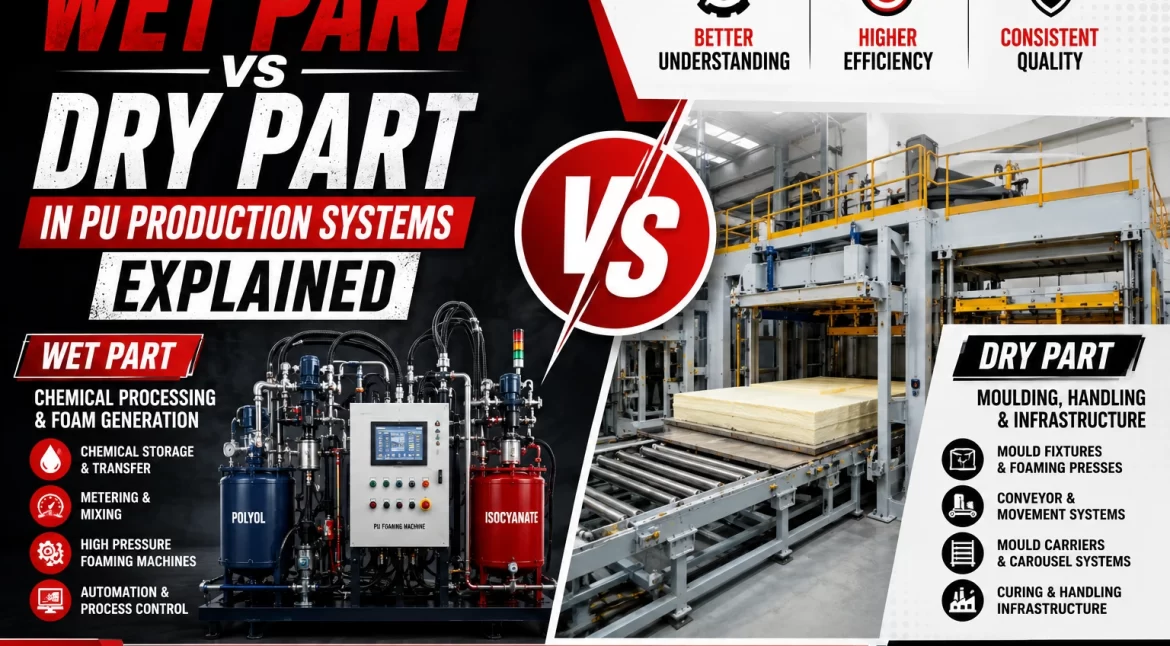
This section includes all systems related to chemical storage, transfer, metering, mixing, and dispensing. The primary chemicals used in polyurethane production are polyol and isocyanate, which must be processed under controlled pressure and temperature conditions to produce the desired foam structure.
The wet part is responsible for ensuring that chemicals are accurately measured and mixed in the correct ratios. Even a small variation in chemical dosing can affect foam density, strength, insulation properties, and product quality.
Modern wet part systems use advanced automation technologies to maintain precise control over processing conditions. These systems are engineered to minimise human error and deliver consistent production results.
The wet part typically includes high-pressure PU foaming machines, metering systems, mixing heads, chemical transfer pipelines, storage tanks, pressure systems, and automation controls.
The quality of the wet part directly impacts the final foam product. Poor chemical control can result in weak foam structures, uneven density, or defective products. This is why modern manufacturers invest heavily in precision wet part engineering.
Importance of Wet Part Systems
The wet part plays a critical role in maintaining consistency and production efficiency.
Since polyurethane foam relies on chemical reactions, accurate dosing and pressure control are essential. The wet part ensures that chemicals are processed safely while maintaining the correct reaction conditions.
Advanced wet part systems also help manufacturers reduce raw material wastage and improve operational cost efficiency. Automated dosing systems optimise chemical usage and reduce unnecessary consumption.
In industries such as refrigeration and construction insulation, foam quality must meet strict thermal and structural standards. The wet part ensures that the foam produced maintains the required performance specifications.
Safety is another important aspect of wet part operations. Polyurethane chemicals and pentane-based systems require controlled environments, pressure monitoring, and ventilation systems to prevent industrial hazards.
What Is the Dry Part in PU Production?
While the wet part focuses on chemical processing, the dry part supports the physical manufacturing and product handling process.
The dry part includes all non-chemical systems involved in shaping, moulding, transporting, and processing foam products during production. It acts as the structural and operational backbone of the manufacturing line.
Dry part systems are designed to improve production flow, product handling, and manufacturing efficiency. These systems help manufacturers scale production while maintaining consistent product dimensions and quality.
The dry part commonly includes mould fixtures, foaming presses, conveyor systems, carousel production setups, sandwich panel lines, mould carriers, curing stations, and handling infrastructure.
In automotive foam production, the dry part manages seat moulds, movement systems, and production line automation. In sandwich panel manufacturing, it supports panel movement, pressing, and shaping operations.
Without an efficient dry part system, even the best chemical processing setup may fail to achieve smooth production flow.
Importance of Dry Part Systems
The dry part is essential for ensuring stable and organised manufacturing operations.
It helps maintain product shape, supports foam expansion during curing, and allows continuous movement of products through the production line. Proper dry part engineering also improves workplace efficiency and reduces manual handling requirements.
In large-scale production facilities, automated dry part systems significantly improve production speed and consistency. They reduce downtime, minimise operational bottlenecks, and help manufacturers meet high-volume production demands.
The dry part also contributes to production safety by ensuring controlled product handling and reducing physical labour risks.
Modern industries increasingly rely on integrated dry-part automation to support advanced manufacturing environments.
How Wet Part and Dry Part Work Together
Although wet and dry systems perform different functions, they must work together seamlessly for successful polyurethane manufacturing.
The wet part generates and dispenses the foam mixture, while the dry part manages moulding, movement, shaping, and curing. A production imbalance between these systems can affect efficiency and product quality.
For example, if the wet part produces foam faster than the dry part can process it, production delays and material wastage may occur. Similarly, weak coordination between systems may result in uneven foam expansion or improper curing.
Modern PU plants use integrated automation systems to synchronise wet and dry operations. This improves process control, production stability, and operational efficiency.
A well-balanced PU production line ensures a smooth workflow from chemical processing to final product manufacturing.
Why Integrated PU Systems Matter
In today’s competitive industrial environment, manufacturers require more than standalone machinery. They need complete production ecosystems that optimise efficiency, quality, and scalability.
Integrated wet and dry systems provide manufacturers with better operational control and long-term production reliability. These systems support automation, reduce labour dependency, improve safety, and minimise material waste.
Industries such as automotive, refrigeration, insulation, and furniture manufacturing increasingly prefer fully integrated polyurethane systems because they deliver higher productivity and consistent product performance.
As production demands continue to grow, manufacturers are investing in complete PU system architecture rather than isolated machinery setups.
Conclusion
The wet part and dry part are two equally important sections of a polyurethane production system. While the wet part handles chemical processing and foam generation, the dry part supports shaping, movement, moulding, and manufacturing operations.
Together, these systems create an efficient and scalable polyurethane production environment capable of meeting modern industrial demands.
Understanding the role of each system helps manufacturers improve production planning, enhance foam quality, optimise efficiency, and maintain long-term operational reliability. Businesses that invest in integrated PU systems are better positioned to achieve consistent production performance and future-ready manufacturing capabilities.
Frequently Asked Questions (FAQs)
1. What is the wet part in a PU production system?
The wet part handles polyurethane chemical processing, including storage, metering, mixing, and foam generation. It is responsible for maintaining accurate chemical ratios and consistent foam quality.
2. What does the dry part do in PU manufacturing?
The dry part supports physical manufacturing operations such as moulding, pressing, curing, handling, and product movement throughout the production process.
3. Why is integration between wet and dry systems important?
Proper integration ensures smooth production flow, better foam quality, reduced downtime, and efficient coordination between chemical processing and manufacturing operations.
4. Which industries use integrated PU production systems?
Industries such as automotive, refrigeration, construction, furniture, insulation, and packaging widely use integrated polyurethane production systems.
Build Advanced PU Manufacturing Systems with Aryanvi PU Solutions Pvt. Ltd.
Aryanvi PU Solutions Pvt Ltd delivers complete polyurethane engineering solutions designed for modern industrial manufacturing. From advanced wet part processing systems to fully integrated dry part production infrastructure, we help businesses build efficient, scalable, and reliable PU manufacturing setups.
Whether you are planning a new PU plant, upgrading existing machinery, or expanding production capacity, Aryanvi provides customised engineering support tailored to your operational goals.