Polyurethane (PU) machines are the backbone of modern insulation panel, refrigeration, construction, automotive, and industrial manufacturing processes. When investing in PU processing equipment, one of the most important decisions is choosing between a High Pressure PU Machine and a Low Pressure PU Machine.
While both technologies are designed to mix and dispense polyurethane chemicals, they differ significantly in terms of operating principle, production capacity, mixing quality, maintenance requirements, and investment cost.
Understanding PU Dispensing Technology
Polyurethane production requires the precise mixing of two primary components—Polyol and Isocyanate. The quality of this mixing directly impacts the final product’s density, strength, insulation performance, and surface finish.
The method used to combine these chemicals determines whether a machine is classified as high-pressure or low-pressure.
What is a High Pressure PU Machine?
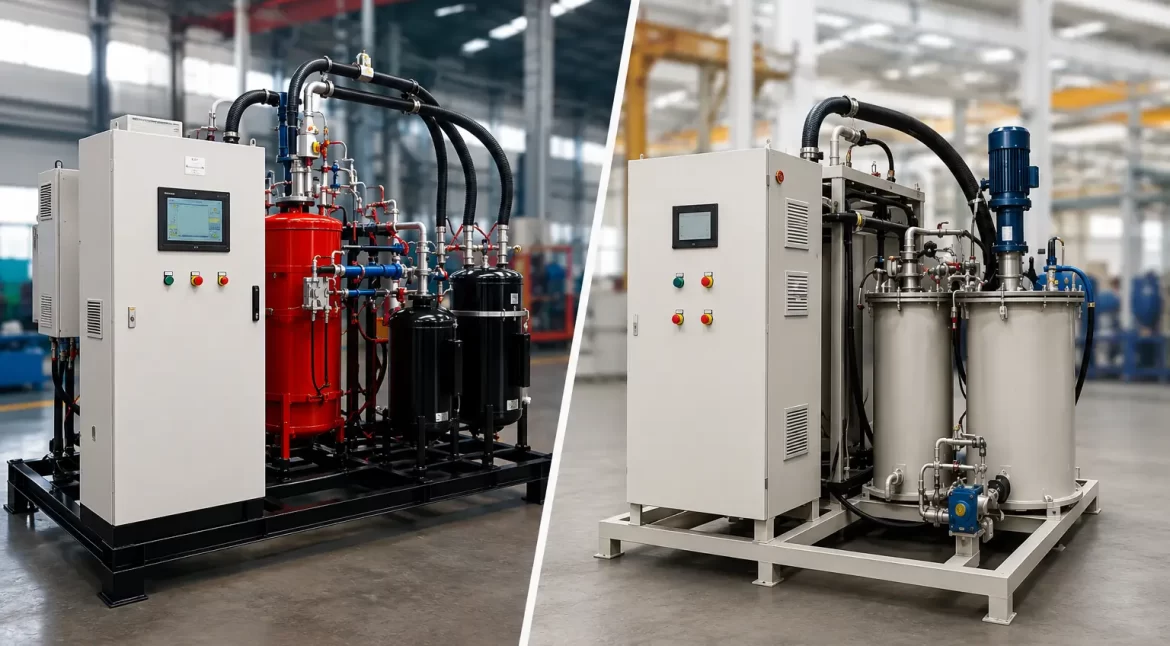
A High Pressure PU Machine mixes polyurethane components at extremely high pressures, typically ranging from 100 to 200 bar. The chemicals collide at high velocity inside a specialized mixing chamber, creating highly efficient and uniform mixing.
Key Features
✔ Superior mixing quality
✔ Consistent foam density
✔ High production output
✔ Minimal material wastage
✔ Suitable for automated production lines
✔ Ideal for continuous manufacturing
Common Applications
- PU Sandwich Panels
- Cold Storage Panels
- Refrigeration Equipment
- Automotive Components
- Insulation Products
- Continuous Production Lines
Advantages
- Excellent foam quality
- Higher productivity
- Better process control
- Reduced raw material waste
- Suitable for large-scale manufacturing
Considerations
- Higher initial investment
- Requires trained operators
- More sophisticated maintenance procedures
What is a Low Pressure PU Machine?
A Low Pressure PU Machine mixes polyurethane components mechanically using an agitator or mixer operating at lower pressures, typically between 5 and 20 bar.
These machines are commonly used for small-scale manufacturing, customized production, and applications where flexibility is more important than production volume.
Key Features
✔ Lower equipment cost
✔ Easy operation
✔ Flexible production capabilities
✔ Suitable for smaller batches
✔ Simple maintenance
Common Applications
- Decorative Products
- Furniture Components
- Molded PU Parts
- Small Production Units
- Research & Development Facilities
- Customized Manufacturing
Advantages
- Lower capital investment
- Easier maintenance
- Suitable for small production volumes
- Greater flexibility for multiple products
Considerations
- Lower production speed
- Higher material consumption
- Less precise mixing compared to high-pressure systems
High Pressure vs Low Pressure PU Machines
| Feature | High Pressure PU Machine | Low Pressure PU Machine |
|---|---|---|
| Mixing Method | High Velocity Impingement Mixing | Mechanical Mixing |
| Operating Pressure | 100–200 Bar | 5–20 Bar |
| Production Capacity | High | Medium to Low |
| Foam Quality | Excellent | Good |
| Material Waste | Very Low | Moderate |
| Automation Level | High | Medium |
| Initial Investment | Higher | Lower |
| Maintenance | Advanced | Simple |
| Best For | Large-Scale Manufacturing | Small & Medium Production |
Which Machine Should You Choose?
Choose a High Pressure PU Machine If:
- You operate a large-scale manufacturing facility.
- Product consistency is critical.
- Production volumes are high.
- Automation is a priority.
- Long-term efficiency matters more than initial investment.
Choose a Low Pressure PU Machine If:
- You are starting a new PU manufacturing business.
- Production volumes are moderate.
- Budget is a key consideration.
- You manufacture customized products.
- Flexibility is more important than speed.
How Aryami PU Solutions Can Help
At Aryami PU Solutions, we provide complete polyurethane engineering solutions tailored to your production requirements. Our team helps manufacturers select the most suitable PU processing technology based on capacity, product type, automation requirements, and future expansion plans.
Whether you require a high-pressure PU machine for industrial-scale production or a low-pressure system for specialized applications, our experts can guide you through machine selection, installation, commissioning, and ongoing technical support.
Conclusion
Both High Pressure and Low Pressure PU Machines play an important role in polyurethane manufacturing. The right choice depends on your production volume, quality requirements, budget, and long-term business goals.
Understanding the differences before investing can help improve productivity, reduce operational costs, and ensure consistent product quality for years to come.