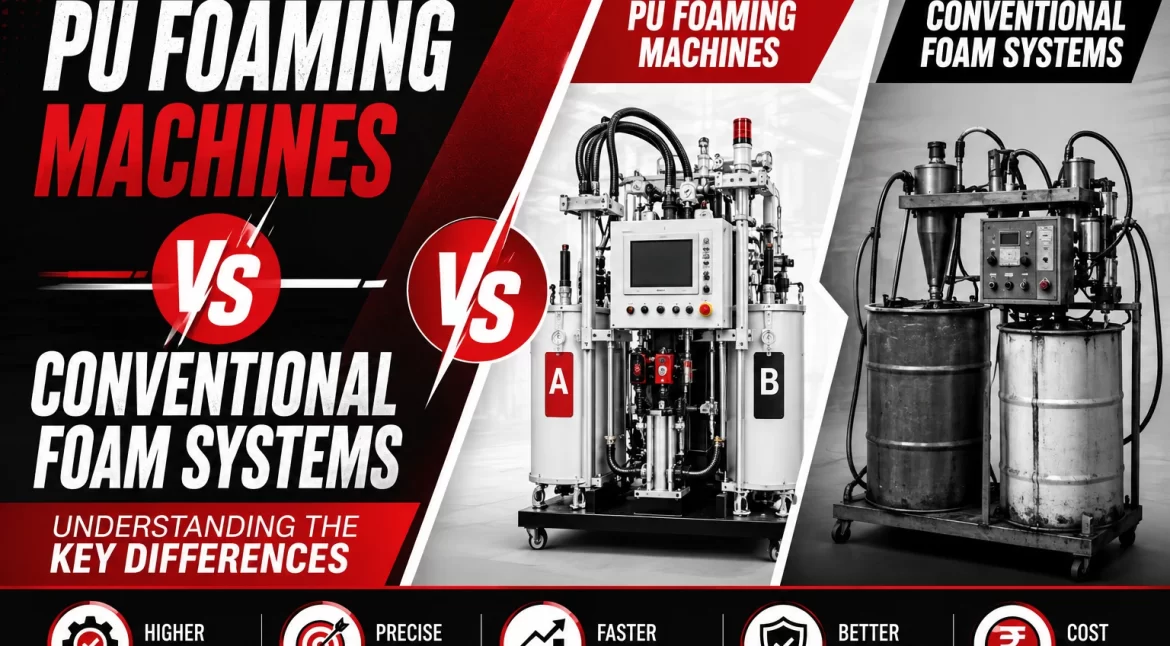
PU Foaming Machines vs Conventional Foam Systems: Understanding the Key Differences
Foam production plays a critical role across sectors such as automotive, construction, refrigeration, furniture, packaging, and insulation. As industries continue to demand higher efficiency, better product quality, and improved durability, polyurethane (PU) foaming technology has become a preferred choice over conventional foam systems.
But what exactly makes PU foaming machines different from traditional foam manufacturing methods? Understanding the differences between these systems is essential for manufacturers planning to improve production efficiency, reduce material waste, and enhance product quality. In this article, we explore the major distinctions between PU foaming machines and conventional foam systems, including their technology, applications, operational efficiency, and long-term benefits.
Understanding PU Foaming Machines
A PU foaming machine is an advanced industrial system designed to process polyurethane chemicals, such as polyol and isocyanate, to create polyurethane foam. These machines use precise metering, mixing, and dispensing technology to produce foam with controlled density, strength, and insulation properties.
PU foaming systems are widely used in industries requiring:
- Thermal insulation
- Flexible foam production
- Rigid foam panels
- Automotive seating
- Refrigerator insulation
- Industrial packaging
- Furniture cushioning
Modern PU foaming machines are highly automated and engineered for precision, consistency, and scalability.
What Are Conventional Foam Systems?
Conventional foam systems usually mean older or simpler ways of making foam that depend on manual work, lower-pressure mixing, or basic foam-making technologies. These systems are commonly used for:
- Basic cushioning products
- Low-volume foam manufacturing
- Traditional upholstery applications
- Simple packaging foam production
While conventional systems may have lower initial setup costs, they often lack the automation, precision, and efficiency offered by modern PU foaming technology.
Key Differences Between PU Foaming Machines and Conventional Foam Systems
1. Technology & Automation
One of the major differences lies in the level of technology used. PU foaming machines operate using automated high-pressure or low-pressure metering systems. These machines precisely control chemical ratios, pressure, temperature, and foam output. Automation reduces human error and ensures consistent product quality.
Conventional foam systems often involve manual chemical mixing or basic low-efficiency machinery. This can lead to inconsistent foam structure, uneven density, and higher rejection rates.
PU Foaming Machine Advantage:
- Fully automated operations
- Better production control
- Consistent foam quality
- Reduced labour dependency
2. Precision & Foam Quality
Precision is critical in industrial foam manufacturing.
PU foaming machines use advanced mixing heads and dosing systems that ensure accurate blending of chemicals. This produces foam with uniform cell structure, consistent density, and superior insulation properties.
Conventional systems may struggle to maintain consistent chemical ratios, resulting in variations in foam quality and performance.
PU Foaming Machine Advantage:
- Uniform foam structure
- Higher product reliability
- Better insulation efficiency
- Improved product durability
3. Production Speed & Efficiency
Modern manufacturing demands faster production with minimal downtime.
PU foaming machines are designed for continuous and high-volume production. Automated systems increase operational efficiency while reducing waste and production delays.
Conventional foam systems are generally slower and more labour-intensive. Manual intervention increases production time and limits scalability.
PU Foaming Machine Advantage:
- Faster production cycles
- Higher output capacity
- Reduced downtime
- Lower operational waste
4. Material Utilisation
Material wastage directly affects manufacturing costs.
PU foaming systems optimise chemical usage through accurate dosing and controlled dispensing. This minimises excess material consumption and improves cost efficiency.
Conventional systems often experience inconsistent chemical mixing, leading to material wastage and increased operational expenses.
PU Foaming Machine Advantage:
- Precise material consumption
- Reduced wastage
- Better cost management
- Higher profitability
5. Energy Efficiency
Energy consumption is a major concern in industrial manufacturing.
Modern PU foaming machines are designed with energy-efficient technologies that optimise heating, pumping, and processing systems.
Conventional foam systems may consume more power due to outdated machinery and inefficient processing methods.
PU Foaming Machine Advantage:
- Lower energy consumption
- Reduced operating costs
- Sustainable manufacturing operations
6. Application Flexibility
PU foaming technology supports a wide range of industrial applications.
Industries such as automotive, refrigeration, insulation, and construction require highly specialised foam products with specific density, strength, and thermal properties. PU machines can be customised to meet these requirements.
Conventional foam systems are generally limited in flexibility and may not support advanced industrial applications.
PU Foaming Machine Advantage:
- Custom foam production
- Suitable for multiple industries
- Flexible manufacturing configurations
7. Safety & Environmental Compliance
Safety is especially important when handling polyurethane chemicals and flammable materials like pentane.
Modern PU foaming systems include advanced safety mechanisms such as the following:
- Pressure monitoring systems
- Ventilation controls
- Gas detection systems
- Explosion-proof components
Conventional systems may not meet modern industrial safety standards, increasing operational risks.
PU Foaming Machine Advantage:
- Improved workplace safety
- Better environmental compliance
- Reduced industrial hazards
Industries Benefiting from PU Foaming Machines
PU foaming machines are widely used across multiple sectors due to their versatility and performance.
Automotive Industry
Used for car seats, headrests, insulation panels, and interior cushioning.
Refrigeration Industry
Essential for refrigerator insulation and thermal efficiency.
Construction Industry
Used in sandwich panels, insulation boards, and energy-efficient buildings.
Furniture & Mattress Industry
Flexible foam production for comfort and durability.
Packaging Industry
Protective foam packaging solutions for industrial products.
Why Industries Are Moving Towards PU Foaming Technology
As global industries focus on automation, sustainability, and production efficiency, PU foaming technology continues to replace traditional foam systems.
Manufacturers are choosing PU machines because they offer:
- Better product quality
- Lower operational costs
- Higher production efficiency
- Advanced automation
- Long-term reliability
- Improved safety standards
The shift towards smart manufacturing and industrial automation is making PU foaming systems an essential investment for future-ready production facilities.
The Bottom Line
While conventional foam systems may still be suitable for small-scale or basic applications, they often fall short in terms of efficiency, consistency, scalability, and safety.
PU foaming machines provide advanced engineering solutions that help manufacturers achieve higher productivity, superior foam quality, and long-term operational savings. Their ability to deliver precise, automated, and scalable foam production makes them the preferred choice across modern industries.
As manufacturing demands continue to evolve, investing in advanced polyurethane processing systems is becoming increasingly important for businesses aiming to stay competitive in global markets.
Frequently Asked Questions (FAQs)
1. What is a PU foaming machine?
A PU foaming machine is industrial equipment used to mix and process polyurethane chemicals for producing foam products used in insulation, automotive, furniture, and refrigeration industries.
2. Are PU foaming machines better than conventional foam systems?
Yes, PU foaming machines offer higher precision, better automation, lower material wastage, improved safety, and consistent foam quality compared to conventional systems.
3. Which industries commonly use PU foaming machines?
Industries such as automotive, construction, refrigeration, furniture, packaging, and appliance manufacturing widely use PU foaming systems.
4. Can PU foaming machines be customised for different applications?
Yes, modern PU systems can be customised based on production requirements, foam density, automation level, and industry-specific applications.
Build Smarter PU Manufacturing Systems with Aryanvi PU Solutions Pvt. Ltd.
Aryanvi PU Solutions Pvt Ltd is a trusted PU foaming machine manufacturer in India, delivering advanced polyurethane processing systems for industries worldwide. From turnkey PU plant solutions to precision foaming equipment, we provide complete engineering support tailored to your production needs.
Whether you are setting up a new plant, upgrading existing systems, or expanding operations, Aryanvi helps you achieve reliable, efficient, and future-ready manufacturing solutions.