Selecting the right polyurethane (PU) machine is one of the most important decisions for any manufacturer involved in insulation panels, refrigeration equipment, construction materials, automotive components, or industrial polyurethane products.
The correct machine improves product quality, increases productivity, reduces material wastage, and ensures long-term operational efficiency. However, with multiple technologies, capacities, and automation levels available, choosing the ideal system can be challenging.
This guide highlights the key factors manufacturers should evaluate before investing in a PU machine.
Understanding Your Production Requirements
Before selecting a machine, manufacturers must clearly define their production objectives.
Key Questions to Consider
- What products will be manufactured?
- What is the required production capacity?
- Is continuous production required?
- What level of automation is needed?
- What is the available budget?
- Are future expansion plans expected?
The answers to these questions will help determine the most suitable PU processing solution.
High Pressure vs Low Pressure Machines
One of the first decisions involves choosing between high-pressure and low-pressure technology.
High Pressure PU Machines
Best suited for:
- Sandwich panel production
- Cold storage panel manufacturing
- Continuous production lines
- Large-scale operations
Benefits:
- Superior mixing quality
- Higher output
- Better foam consistency
- Reduced material wastage
Low Pressure PU Machines
Best suited for:
- Customized products
- Molded components
- Small to medium production volumes
- Flexible manufacturing environments
Benefits:
- Lower investment cost
- Easier maintenance
- Greater production flexibility
Production Capacity Assessment
Machine capacity should align with current and future production goals.
Small Capacity Operations
Suitable for:
- Startups
- Small manufacturing facilities
- Prototype development
Medium Capacity Operations
Suitable for:
- Regional manufacturers
- Growing production facilities
- Multiple product lines
Large Capacity Operations
Suitable for:
- Continuous production plants
- Export-focused manufacturers
- High-volume operations
Choosing an oversized or undersized machine can negatively impact profitability and efficiency.
Automation Requirements
Modern PU manufacturing increasingly relies on automation to improve consistency and reduce labor dependency.
Manual Systems
Advantages:
- Lower investment
- Flexible operation
Suitable for:
- Small production facilities
- Specialized manufacturing
Semi-Automatic Systems
Advantages:
- Improved efficiency
- Better process control
Suitable for:
- Expanding manufacturers
- Medium-scale operations
Fully Automatic Systems
Advantages:
- Maximum productivity
- Consistent product quality
- Reduced human error
Suitable for:
- Large-scale industrial production
Product Type Considerations
Different products require different machine configurations.
PU Sandwich Panels
Recommended:
- High-pressure dispensing systems
- Continuous production capability
Refrigeration Products
Recommended:
- Precision dosing systems
- High-quality foam control
Molded Components
Recommended:
- Flexible low-pressure systems
- Multi-mold capability
Construction Insulation
Recommended:
- Automated mixing and dispensing systems
- High production efficiency
Raw Material Handling Systems
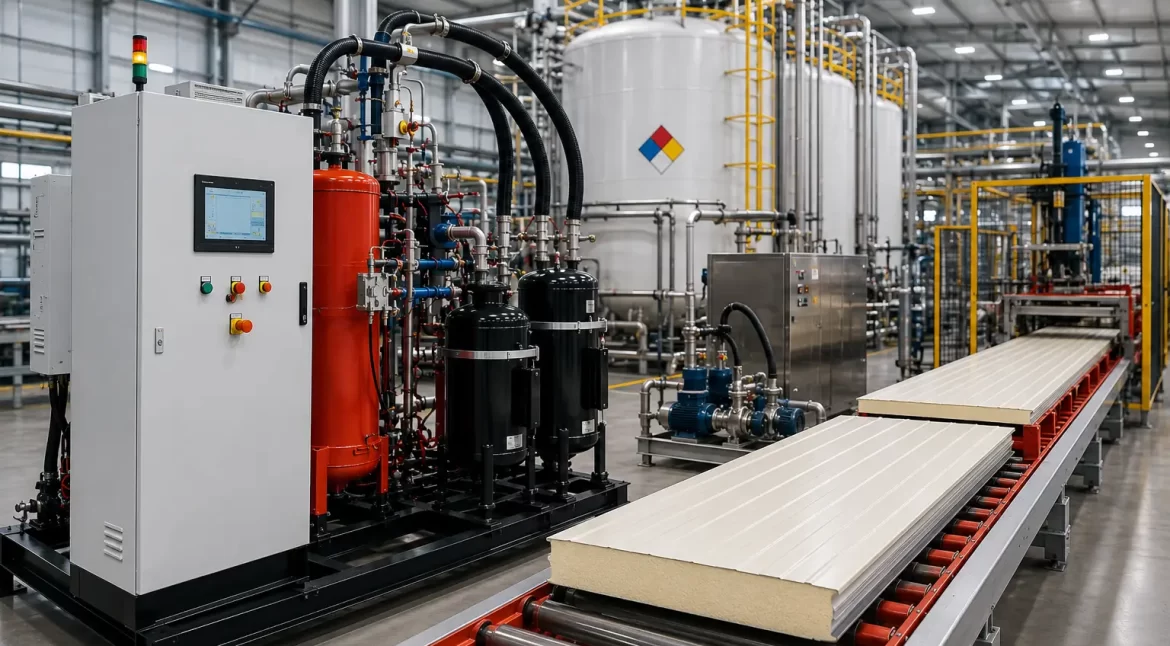
A complete PU production setup often includes additional systems beyond the dispensing machine.
Essential Components
- Storage Tanks
- Pentane Systems
- Temperature Control Units
- Transfer Pumps
- Piping Networks
- Automation Controls
Integrated systems improve process stability and operational safety.
Safety and Compliance
Safety should never be overlooked when selecting PU machinery.
Important Safety Features
- Emergency stop systems
- Pressure monitoring
- Leak detection
- Explosion-proof components
- Safety interlocks
- Ventilation integration
Compliance with international safety standards protects both personnel and equipment.
Maintenance and Technical Support
Long-term machine performance depends heavily on maintenance and support availability.
Before purchasing, evaluate:
- Spare parts availability
- Technical service support
- Operator training programs
- Remote troubleshooting capabilities
- Preventive maintenance services
Reliable support reduces downtime and increases machine lifespan.
Future Expansion Planning
Many manufacturers outgrow their initial equipment faster than expected.
When selecting a machine, consider:
- Future production increases
- Additional product lines
- Automation upgrades
- Facility expansion plans
Scalable equipment often provides better long-term value.
Why Work with Aryanvi PU Solutions?
At Aryanvi PU Solutions, we help manufacturers select, install, and optimize polyurethane processing systems tailored to their production requirements.
Our services include:
✔ PU Machine Selection
✔ Storage Systems Design
✔ Pentane System Engineering
✔ Industrial Piping Solutions
✔ Installation & Commissioning
✔ Retrofitting Services
✔ Technical Consultancy
We focus on delivering complete engineering solutions that maximize productivity, safety, and long-term operational performance.
Conclusion
Selecting the right PU machine requires careful evaluation of production capacity, product requirements, automation needs, safety considerations, and future growth plans.
A properly selected polyurethane system can significantly improve manufacturing efficiency, reduce operating costs, and ensure consistent product quality for years to come.